
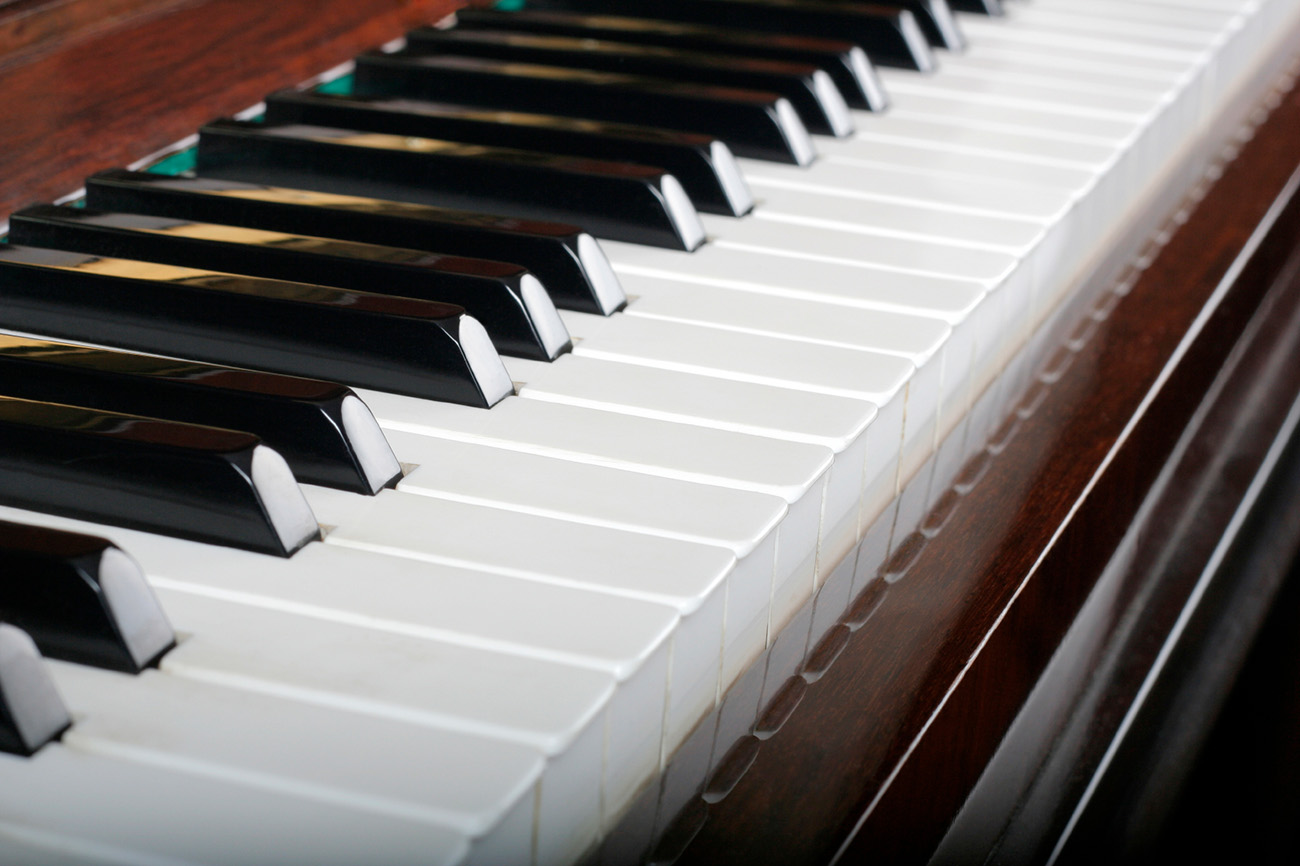
The keyboard has played such an important role in Western Classical music as a solo instrument, as an accompanist and as a member of chamber and latterly, as part of the symphony orchestra too.
This course will explore the keyboard in general, and focus on the piano as a solo instrument and the piano sonata as a vehicle for musical expression and a structure for composition. We will listen to works from the baroque, classical period and romantic periods and in the last week, music from the 20th century.
Course outline
Week 1: Early Keyboards - the harpsichord - Bach and Scarlatti
Week 2: The pianoforte - Haydn and Mozart
Week 3: Beethoven
Week 4: Schubert
Week 5: Chopin and Liszt
Week 6: Scriabin
The piano sonata is one of the central forms in Western instrumental music, evolving over nearly three centuries as both a testing ground for compositional ideas and a vehicle for personal expression.
In the Baroque period, the word “sonata” simply meant “a piece to be sounded” (suonare) as opposed to “cantata,” a piece to be sung. Keyboard sonatas existed, but they lacked a fixed structure. Composers like Domenico Scarlatti wrote hundreds of single-movement sonatas for harpsichord: compact, virtuosic, often binary in form, with clear tonal contrasts and brilliant passagework. These early sonatas helped establish expressive possibilities for solo keyboard but were not yet the multi-movement, architecturally unified works we associate with the classical piano sonata.
The real crystallization of the piano sonata came in the Classical era, roughly the late 18th century. As the fortepiano replaced the harpsichord, composers exploited its dynamic range and cantabile tone. Sonata form—exposition, development, recapitulation—emerged as a powerful way to dramatize musical ideas through contrast, conflict, and resolution. Joseph Haydn and Wolfgang Amadeus Mozart wrote numerous keyboard sonatas in two or three movements, typically combining a fast, formally rigorous opening with lighter, dance-inspired or lyrical subsequent movements. These works codified basic expectations: a first movement in sonata form, a contrasting slow movement, and often a lively finale.
Ludwig van Beethoven expanded the genre both technically and philosophically. His 32 piano sonatas pushed the form from salon entertainment to something like a “laboratory of ideas.” Early sonatas still fit Classical patterns, but middle- and late-period works radically stretched them. Beethoven experimented with number of movements, large-scale key relationships, motivic unity across an entire sonata, and extreme dynamic and emotional contrasts. Works like the “Moonlight,” “Waldstein,” and “Hammerklavier” sonatas reimagined what a solo keyboard piece could express, turning the pianist into a kind of orchestral storyteller.
In the Romantic era, the sonata form remained important but became more flexible and personal. Composers like Schubert, Schumann, Chopin, and Liszt absorbed Beethoven’s legacy while bending the structure toward their own voices. Schubert’s late sonatas, expansive and harmonically adventurous, linger in distant keys and long-breathed melodies. Chopin’s sonatas combine classical outlines with highly idiomatic piano writing and intense lyricism. Liszt went further by compressing multi-movement structures into single, continuous spans, as in his monumental Sonata in B minor, where traditional sonata logic is hidden inside a continuous transformation of themes.
By the late 19th and 20th centuries, the piano sonata became both tradition and challenge. Brahms engaged deeply with classical models, while later composers like Scriabin, Prokofiev, and Shostakovich used the sonata as a framework for increasingly chromatic or modern languages. The form’s basic idea—contrasting themes articulated over a large-scale harmonic journey—proved adaptable to atonality, neoclassicism, and beyond. Even as new genres and media emerged, the piano sonata remained a touchstone: a place where composers could measure themselves against history while redefining it.
Today, the piano sonata stands as both a historical monument and a living form. Its evolution traces changing ideas about structure, virtuosity, and subjectivity, from Baroque craft through Classical clarity and Romantic introspection to modern experimentation.
The musical keyboard evolved from ancient monochords into today’s expressive, standardized piano-style interface.
The story starts with ancient stringed instruments like the monochord. These had a single string and movable bridges, used to study pitch relationships. Over time, builders added more strings and experimented with ways to choose notes more quickly and accurately.
By the Middle Ages, early key-based instruments appeared. The organ is the first true “keyboard” instrument. Its levers and keys opened valves for air to pass through pipes. Early keys were long, heavy wooden levers, played with the whole hand. Gradually they became shorter, lighter, and closer to the shape we recognize.
Around the 14th–15th centuries, plucked-keyboard instruments like the clavichord and harpsichord emerged. The clavichord used small metal tangents to strike strings, allowing very subtle control but low volume. The harpsichord plucked the strings with plectra, giving a bright, consistent sound but almost no dynamic variation. Both helped establish the visual layout of the keyboard and the idea of a fixed pattern of white and black keys.
As musical language grew more harmonically complex, tuning systems evolved. Early keyboards used meantone and other temperaments, which favored certain keys and made others sound harsh. By the 18th century, equal temperament became more common. This made all keys usable, and it encouraged the standardization of the familiar pattern: repeating groups of seven white and five black keys.
The piano, invented by Bartolomeo Cristofori around 1700, was the key turning point. Its hammer mechanism allowed players to control dynamics by touch. Over the 18th and 19th centuries, the piano’s keyboard became heavier, more responsive, and more standardized in size and range. By the late Romantic period, the modern 88-note layout was largely fixed.
In the 20th century, the keyboard interface detached from acoustic strings and pipes. Early electronic organs and synthesizers kept the same key layout because performers already knew it. Analog synths of the 1960s and 70s treated the keyboard as a controller for voltage, not just sound production. This made pitch bend, modulation, and new timbres possible, while keeping the old physical vocabulary of black and white keys.
Late 20th and early 21st century developments focused on expressiveness and integration. MIDI keyboards turned the piano layout into a universal control surface for digital instruments. New designs like weighted keys, aftertouch, and continuous controllers added nuance. Alternative “keyboards” such as isomorphic grids and multidimensional surfaces challenged the dominance of the piano layout, but the traditional keyboard remains the default interface for most Western music technology.
Across this history, the constant thread is human hands searching for a reliable, expressive way to organize pitch in space. The modern keyboard is the result: a visually simple, deeply evolved map of notes that now spans acoustic, electronic, and digital worlds.
Choose a Subscription that suits you
An Annual Subscription
Gives you access to all videos, resources live and recorded courses on the site for 12 months from the date of purchase.
Courses: Live courses (on ZOOM) are held 3 times a year - in September, January and June. Each course consists of six, 90 minute sessions held on a Wednesday evening at 7.30pm (UK time). The sessions are recorded and edited into a video which is uploaded to the site, usually within a week. If you miss a session, you will be able to catch up by watching the recorded video in your own time. Some people prefer not to attend the LIVE sessions and just watch the recorded videos.
Videos: The Thinking Arts website has a growing catalogue of videos (currently 50+) which you will be able to access at any time. The videos are usually about 90 minutes long and cover a wide range of subjects - music history, chamber music, vocal music, the concerto, the symphony, contemporary music and many more.